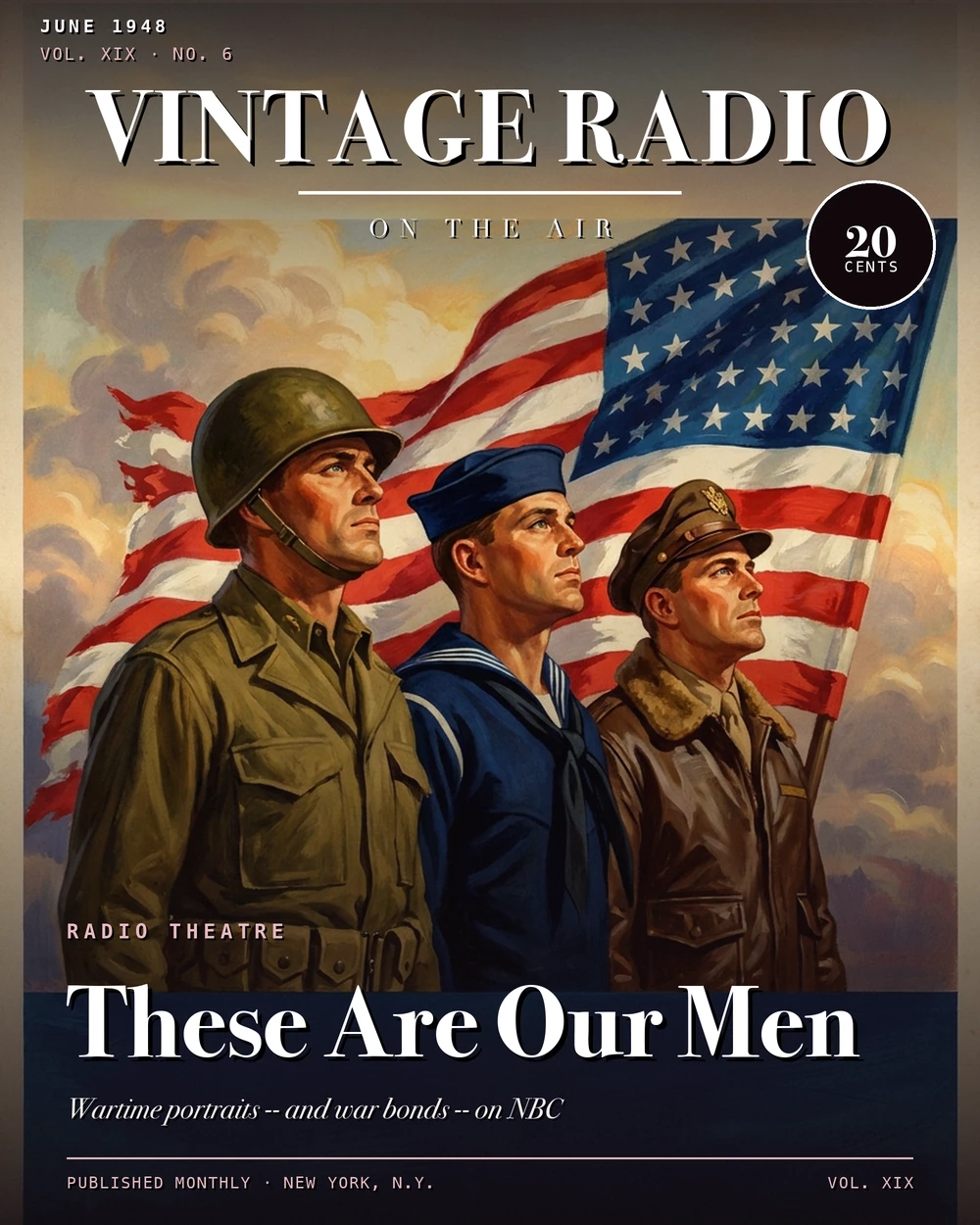
These Are Our Men
What It Was and Why It Existed
These Are Our Men ran on NBC for eleven Saturday afternoons at two o'clock, from December 2, 1944 to February 17, 1945 — a short, focused run with a specific purpose. The series presented dramatic profiles of American military leaders during the Sixth War Loan Drive, the penultimate U.S. war bond campaign of World War II. Each 30-minute episode told the life story of one figure, drawing from school years through active command, and closed with a celebrity delivering a war bond sales message. The Parker Watch Company sponsored the show but turned its commercial time over to the bond cause entirely, making the sales pitch the point of the whole enterprise rather than an interruption within it.
The show's own description called these "dramatic profiles of these men of ours who will lead us to victory," and the eleven subjects formed a roster of the war's most prominent American figures: Franklin Roosevelt, General George C. Marshall, General Dwight D. Eisenhower, General Henry H. Arnold, Lieutenant General Jonathan Mayhew Wainwright, Admiral Ernest J. King, General Douglas MacArthur, Lieutenant General A. A. Vandegrift, Admiral Chester W. Nimitz, General George S. Patton, and war correspondent Ernie Pyle. Pyle was the only non-military subject, and his episode dramatized his 1944 book Brave Men, which had reached number one on the bestseller lists that same year.
The Talent They Assembled
The celebrity bond-sellers read like a marquee for a major broadcast event. Frank Sinatra delivered the bonds message on the opening episode about President Roosevelt. Jack Benny appeared on the Nimitz episode, Ralph Bellamy on Eisenhower, Miriam Hopkins on Patton, and Ralph Edwards on MacArthur. The full roster across the run also included Franchot Tone, Paul Muni, Tallulah Bankhead, Jean Hersholt, Richard Arlen, and Robert Merrill. Persuading that many prominent names to appear across eleven weeks took organizational reach, though the wartime context made participation a matter of public obligation as much as scheduling.
The drama itself was performed by New York radio actors, including Staats Cotsworth and Bill Adams. Announcer Jack Costello and director Anton M. Leader handled the production, while Cotsworth served as narrator, framing each episode by calling upon a personified character named "History" to introduce the dramatic sketches. The scenes ranged from childhood and school years to behind-the-scenes portraits of command during major wartime campaigns.
The People Behind the Microphone
Staats Cotsworth was well suited to anchor a prestige wartime production. Born in Oak Park, Illinois, on February 17, 1908, he had trained as a classical actor with Eva Le Gallienne's Civic Repertory Theatre in New York, where Burgess Meredith and Parker Fennelly were among his fellow cast members. By the mid-1940s he had become what one journalist called "the busiest actor in radio," with an estimated 7,500 broadcasts over twelve years to his credit. At the peak of his career, when the average American salary ran around $3,000 a year, Cotsworth was earning over $50,000 annually from radio alone. His best-known role was the title character in Casey, Crime Photographer on CBS, which he played from 1943 to 1955. Another journalist nicknamed him "the Clark Gable of radio."
Director Anton M. Leader had been working at NBC since 1941, interrupted by a leave of absence in 1942–1943 when he enlisted and served in the Army Air Corps. He directed Words at War and The Eternal Light for NBC around the same period as These Are Our Men. After leaving NBC in 1946 he went on to direct for CBS and Mutual — including Suspense, Murder at Midnight, and The Whisper Men — and later built a television career that took in episodes of Star Trek, The Virginian, Daniel Boone, Ironside, and Hawaii Five-O, as well as the 1964 feature Children of the Damned.
The Sponsor and Its Tie-In
The Parker Watch Company, registered in New York City on January 1, 1927 under the name of Saul Parker, had a promotional strategy that went beyond the broadcast itself. The company offered listeners a book-portfolio featuring photographs and biographies of the American leaders profiled on the show. The portfolio sleeve was designed to store War Bonds, and it included space for recording bond serial numbers — connecting the sponsor's premium directly to the act of buying bonds. It was an unusually complete piece of wartime marketing. The Parker Watch Company folded in 1951, roughly six years after the series ended.
The show aired during a moment when the radio industry was deeply invested in the bond effort. A January 30, 1945 report in the New York newspaper PM estimated that the radio industry had donated approximately $66,141,600 worth of time and talent to war information agencies in 1944 alone. These Are Our Men sat within that broader landscape, running alongside other NBC bond programs including Treasury Star Parade and Treasury Star Salute.
Ten episodes survive, with a total recorded running time of about five hours.